By Fergus WalshMedical editor Por Fergus Walsh, Editor Médico

 Getty Images
Getty Images
Getty Images
Alzheimer's patients could lose out on two groundbreaking new drugs because the NHS is unprepared, a leading charity has told BBC Panorama. Los pacientes de Alzheimer podrían perder la oportunidad de acceder a dos nuevos medicamentos innovadores porque el NHS no está preparado, según ha informado una destacada organización benéfica a BBC Panorama.
Lecanemab and donanemab slow down the early stages of the disease - which is the most common form of dementia. Lecanemab y donanemab ralentizan las primeras etapas de la enfermedad, que es la forma más común de demencia.
But Alzheimer's Research UK says the NHS is not ready to roll out the drugs, which could be licensed this year. Pero Alzheimer's Research UK afirma que el NHS no está listo para implementar los medicamentos, los cuales podrían recibir licencia este año.
The treatments would then be subject to an assessment of cost and benefits before they are made available. Luego, los tratamientos estarían sujetos a una evaluación de costos y beneficios antes de estar disponibles.
Lecanemab and donanemab represent a step forward because they target one of the causes of Alzheimer's, rather than treating the symptoms. Lecanemab y donanemab representan un avance porque se enfocan en una de las causas del Alzheimer, en lugar de tratar los síntomas.
However, their effectiveness depends on early diagnosis - and very few people have the specialist scans or investigations which would be needed. Sin embargo, su efectividad depende de un diagnóstico temprano, y muy pocas personas tienen las exploraciones o investigaciones especializadas que serían necesarias.
Questions also remain over potentially harmful side-effects of the drugs and whether the benefit they offer represents value for NHS money. También existen dudas sobre los posibles efectos secundarios perjudiciales de los medicamentos y si el beneficio que ofrecen representa un valor para el dinero del NHS.
Dawn, who's 62 and from Hampshire, is on a new donanemab trial, aimed at studying optimum dosing levels. Dawn, de 62 años y procedente de Hampshire, está en un nuevo ensayo clínico con donanemab, destinado a estudiar los niveles óptimos de dosis.
She started noticing memory problems last year, forgetting recent events and sometimes struggling to follow a television programme. Empezó a notar problemas de memoria el año pasado, olvidando eventos recientes y a veces teniendo dificultades para seguir un programa de televisión.
"I just knew something wasn't right," she says. "Simplemente sabía que algo no estaba bien", dice.
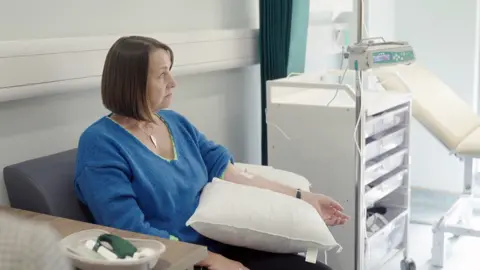
Dawn receives her donanemab treatment through IV infusion Dawn recibe su tratamiento de donanemab a través de infusión intravenosa.
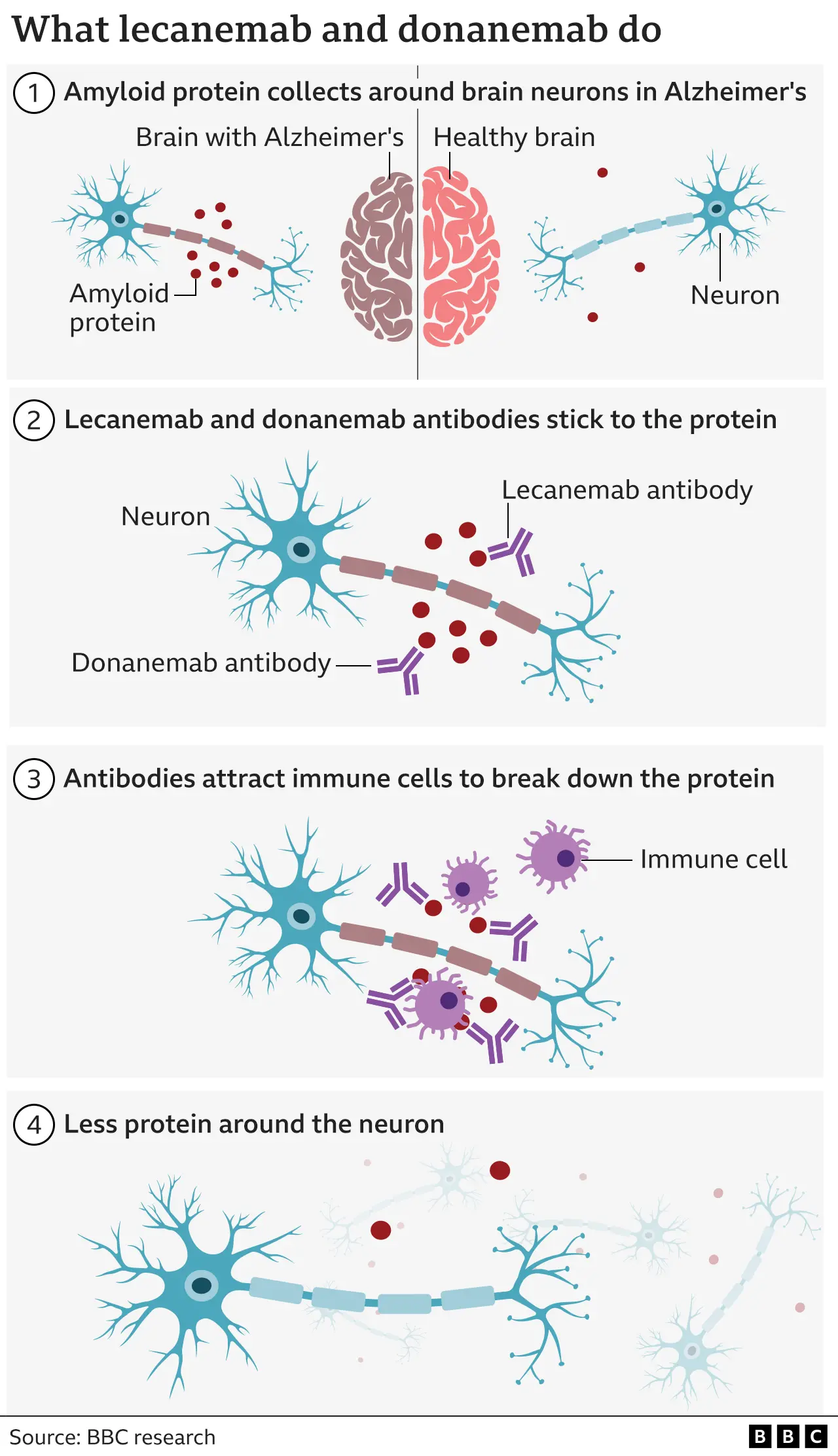
Tests revealed raised levels of a rogue protein in her brain called amyloid - a key marker of Alzheimer's disease. Las pruebas revelaron niveles elevados de una proteína rebelde en su cerebro llamada amiloide, un marcador clave de la enfermedad de Alzheimer.
Amyloid forms clumps or plaques around neurons, which are cells in the brain that transmit information and instructions throughout the body. El amiloide forma grupos o placas alrededor de las neuronas, que son células en el cerebro que transmiten información e instrucciones por todo el cuerpo.
This process can start up to 20 years before the damage to brain cells becomes apparent and the first symptoms of dementia emerge, such as memory loss, or confusion. Este proceso puede comenzar hasta 20 años antes de que el daño a las células cerebrales sea evidente y aparezcan los primeros síntomas de demencia, como pérdida de memoria o confusión.
Donanemab and lecanemab are antibodies, like those made by our body to attack viruses or bacteria. They have both been engineered to bind to amyloid and help our immune system clear it from the brain. Donanemab y lecanemab son anticuerpos, como los que produce nuestro cuerpo para atacar virus o bacterias. Ambos han sido diseñados para unirse al amiloide y ayudar a nuestro sistema inmunológico a eliminarlo del cerebro.
Dawn is hopeful the drug will help her: "If it slows it down, then I'll be able to function as I'd like to and do some of the things I'd still like to do." Dawn tiene esperanzas de que el medicamento la ayude: "Si lo ralentiza, podré funcionar como me gustaría y hacer algunas de las cosas que aún me gustaría hacer".

Alzheimer's: A Turning Point? ¿Alzheimer: ¿Un punto de inflexión?
Fergus Walsh follows patients with Alzheimer's disease, who have been taking two new drugs that have been shown to slow down its progression. Is this a turning point in its treatment? Fergus Walsh sigue a pacientes con enfermedad de Alzheimer que han estado tomando dos nuevos medicamentos que han demostrado ralentizar su progresión. ¿Es este un punto de inflexión en su tratamiento?
Watch on BBC One on 12 February at 20:00 (20:30 in Northern Ireland and 22:40 in Wales) or on BBC iPlayer now (UK Only) **Mira en BBC One el 12 de febrero a las 20:00 (20:30 en Irlanda del Norte y 22:40 en Gales) o en BBC iPlayer ahora (solo en el Reino Unido)

In global trials involving hundreds of early-stage Alzheimer's patients, the drugs were shown to slow cognitive decline by between about a quarter and a third over 18 months. En ensayos globales que involucraron a cientos de pacientes en etapas tempranas de Alzheimer, se demostró que los medicamentos ralentizaban el declive cognitivo entre aproximadamente una cuarta parte y un tercio en 18 meses.
Consultant neurologist Dr Cath Mummery, who is head of clinical trials at the Dementia Research Centre, University College London, says this would make a meaningful, if small, difference to individual patients: "Over 18 months, that gives you about five months at a higher function." La neuróloga consultora Dra. Cath Mummery, quien es jefa de ensayos clínicos en el Centro de Investigación de Demencia de University College London, dice que esto haría una diferencia significativa, aunque pequeña, para los pacientes individuales: "Durante 18 meses, eso te da alrededor de cinco meses en un nivel de función más alto".
Lecanemab - produced by Eisai and Biogen - is already licensed in the US where it costs about £20,000 per patient per year. Lecanemab - producido por Eisai y Biogen - ya está autorizado en los Estados Unidos donde cuesta alrededor de £20,000 por paciente al año.
The UK medicines regulator - the Medicines and Healthcare products Regulatory Agency (MHRA) - is assessing the drugs and is expected to approve lecanemab within the next few months, with the licence for donanemab - made by Eli Lilly - following slightly later. El regulador de medicamentos del Reino Unido - la Agencia Reguladora de Medicamentos y Productos Sanitarios (MHRA) - está evaluando los medicamentos y se espera que apruebe lecanemab en los próximos meses, con la licencia para donanemab - fabricado por Eli Lilly - llegando un poco más tarde.
However, both drugs come with potentially serious side effects, most notably swelling and bleeding in the brain. Three of the 853 people who took donanemab during the clinical trial, died as a result of the treatment. Sin embargo, ambos medicamentos vienen con efectos secundarios potencialmente graves, especialmente hinchazón y sangrado en el cerebro. Tres de las 853 personas que tomaron donanemab durante el ensayo clínico fallecieron como resultado del tratamiento.
As a result, patients need very careful monitoring via MRI brain scans. Como resultado, los pacientes necesitan un monitoreo muy cuidadoso a través de resonancias magnéticas cerebrales.
The side effects of the drugs and their limited effectiveness has led some critics to dismiss them as a dead end. Los efectos secundarios de los medicamentos y su efectividad limitada han llevado a que algunos críticos los descarten como un callejón sin salida.
Dr Cath Mummery disagrees. La Dra. Cath Mummery no está de acuerdo.
She says, "For the first time, we've got drugs that show that you can alter the course of Alzheimer's disease, and that's an extraordinary thing." Ella dice: "Por primera vez, tenemos medicamentos que muestran que se puede alterar el curso de la enfermedad de Alzheimer, y eso es algo extraordinario."

Consultant neurologist Dr Cath Mummery: The new drugs offer a new approach to tackling Alzheimer's La Dra. Mummery, neuróloga consultora: Los nuevos medicamentos ofrecen un nuevo enfoque para abordar el Alzheimer.
Dr Mummery believes this may be the first move towards managing Alzheimer's as a chronic disease and keeping sufferers well and stable for as long as possible. Until now, she says, doctors could only give supportive and palliative care for what is, in effect, a terminal disease. La Dra. Mummery cree que este puede ser el primer paso hacia el manejo del Alzheimer como una enfermedad crónica y mantener a los pacientes lo más saludables y estables posible. Hasta ahora, dice, los médicos solo podían brindar cuidados de apoyo y paliativos para lo que es, en efecto, una enfermedad terminal.
But even if the drugs are licensed in the UK, it does not mean they will be immediately available on the NHS. Pero incluso si los medicamentos son autorizados en el Reino Unido, no significa que estarán disponibles de inmediato en el NHS.
The National Institute for Health and Care Excellence (NICE) and the Scottish Medicines Consortium will assess the effectiveness of lecanemab and donanemab, and whether they represent value for money. El Instituto Nacional de Excelencia Clínica (NICE) y el Consorcio de Medicamentos de Escocia evaluarán la efectividad de lecanemab y donanemab, y si representan un buen valor por su costo.
A briefing paper for NHS England estimates that between 50,000 and 280,000 patients might be eligible for the new treatments if NICE recommends that the drugs are used by the health service. The cost of the drugs - and administering the treatment - would be between £500m and £1bn per year. Un documento informativo para NHS England estima que entre 50,000 y 280,000 pacientes podrían ser elegibles para los nuevos tratamientos si NICE recomienda que los medicamentos sean utilizados por el servicio de salud. El costo de los medicamentos - y la administración del tratamiento - estaría entre £500 millones y £1 mil millones por año.
However, even if the drugs are approved, Alzheimer's charities say that the NHS is unprepared for their delivery. Sin embargo, incluso si los medicamentos son aprobados, las organizaciones benéficas de Alzheimer dicen que el NHS no está preparado para su entrega.

Support information about dementia / Alzheimer's can be found through BBC Action Line. Se puede encontrar información de apoyo sobre demencia / Alzheimer a través de BBC Action Line.
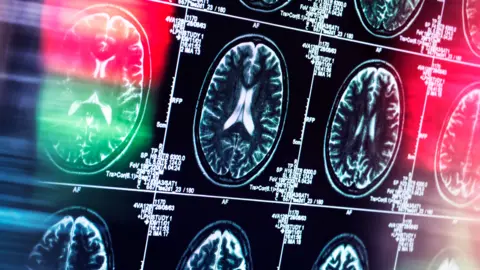
To be eligible for either drug, patients would have to be in the early stages of Alzheimer's and have had a PET scan or lumbar puncture to confirm high levels of amyloid in their brain. Currently, only 2% of dementia patients receive either of these "gold standard" methods of diagnosis, according to Alzheimer's Research UK. Para ser elegible para cualquiera de los medicamentos, los pacientes tendrían que estar en las primeras etapas del Alzheimer y haber tenido una tomografía por emisión de positrones (PET) o una punción lumbar para confirmar altos niveles de amiloide en su cerebro. Actualmente, solo el 2% de los pacientes con demencia reciben cualquiera de estos métodos de diagnóstico "de oro", según la Investigación de Alzheimer del Reino Unido.
It is hoped that a blood test to detect amyloid levels may be available within five years. However, Dr Susan Kohlhaas, director of research at Alzheimer's Research UK, says that, currently, fewer than two thirds of sufferers receive any dementia diagnosis at all. Se espera que una prueba de sangre para detectar los niveles de amiloide pueda estar disponible en un plazo de cinco años. Sin embargo, la Dra. Susan Kohlhaas, directora de investigación de Alzheimer's Research UK, afirma que actualmente menos de dos tercios de los afectados reciben algún diagnóstico de demencia en absoluto.
"Would we accept that for any other disease area, much less than for the biggest killer in the UK?" she asks. "This is a major issue that we need to start addressing now." "¿Aceptaríamos esto para cualquier otra área de enfermedad, mucho menos para la mayor causa de muerte en el Reino Unido?" se pregunta. "Este es un problema importante que necesitamos empezar a abordar ahora."
NHS England says that the pandemic had a "significant impact" on dementia diagnosis rates, but (as of November 2023) they are the highest they have been in three years. It adds that a dedicated programme team has been established "to accelerate NHS preparations for the rollout of any future Alzheimer's treatment". El NHS England dice que la pandemia tuvo un "impacto significativo" en las tasas de diagnóstico de demencia, pero (a partir de noviembre de 2023) son las más altas en tres años. Añade que se ha establecido un equipo de programa dedicado "para acelerar los preparativos del NHS para la implementación de cualquier futuro tratamiento para el Alzheimer".
Paul, 73, from North Yorkshire, first started noticing his loss of memory a couple of years ago and it has since got worse. Paul, de 73 años, de Yorkshire del Norte, comenzó a notar la pérdida de memoria hace un par de años y desde entonces ha empeorado.
He was referred for a brain scan by his GP and then waited five months for an appointment with a memory clinic. He still does not have a formal diagnosis. Fue referido para una resonancia magnética cerebral por su médico de cabecera y luego esperó cinco meses para una cita en una clínica de memoria. Todavía no tiene un diagnóstico formal.
He says the delays have made him "really worried and upset" because his condition has deteriorated in recent months, and he is aware that the new drugs need to be given to those with only mild symptoms of Alzheimer's. Él dice que las demoras lo han hecho sentir "realmente preocupado y molesto" porque su condición ha empeorado en los últimos meses, y es consciente de que los nuevos medicamentos deben ser administrados a aquellos con solo síntomas leves de Alzheimer.
"I have a young family, so the longer I can be around the better." "Tengo una familia joven, así que cuanto más tiempo pueda estar aquí, mejor."
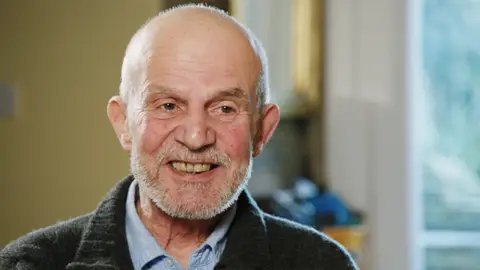
Delays in formal diagnosis have left Paul "worried and upset" Las demoras en el diagnóstico formal han dejado a Paul "preocupado y molesto".
For most people, advancing age is the biggest risk factor for Alzheimer's. Para la mayoría de las personas, la edad avanzada es el factor de riesgo más grande para el Alzheimer.
But in rare cases it is triggered by a faulty gene, meaning the onset of symptoms can happen in someone's 30s. Pero en casos raros, es desencadenado por un gen defectuoso, lo que significa que la aparición de síntomas puede ocurrir en los 30 años de alguien.
Pete, 33, from North Lincolnshire, lives under the shadow of Alzheimer's. His mother first developed symptoms of cognitive decline around his age and died from Alzheimer's aged 41. Pete, de 33 años, de Lincolnshire del Norte, vive bajo la sombra del Alzheimer. Su madre desarrolló por primera vez síntomas de deterioro cognitivo alrededor de su edad y murió de Alzheimer a los 41 años.
A genetic test in 2018 confirmed that Pete had inherited a rare gene for early-onset Alzheimer's called presenilin 1. Una prueba genética en 2018 confirmó que Pete había heredado un gen raro para el Alzheimer de inicio temprano llamado presenilina 1.
It was passed down from his mother and grandmother, who also developed Alzheimer's in her 30s. With each generation there is a 50:50 chance that children will have inherited the gene. Fue heredado de su madre y su abuela, quien también desarrolló Alzheimer en sus 30 años. Con cada generación, hay un 50:50 de posibilidades de que los niños hayan heredado el gen.
Pete has no symptoms at present and is part of a clinical trial of two Alzheimer's drugs. Lecanemab is one of those, as it targets amyloid - while the other is E2814, which targets tau, another protein implicated in the development of the disease, which forms tangles inside neurons, harming their ability to communicate. Pete no tiene síntomas en la actualidad y forma parte de un ensayo clínico de dos medicamentos para el Alzheimer. Lecanemab es uno de ellos, ya que se dirige al amiloide, mientras que el otro es E2814, que se dirige al tau, otra proteína implicada en el desarrollo de la enfermedad, que forma enredos dentro de las neuronas, dañando su capacidad de comunicarse.
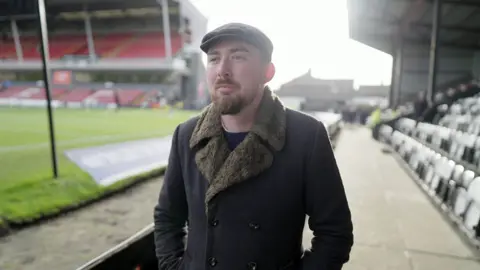
Pete hopes his treatment will delay the onset of Alzheimer's indefinitely Pete espera que su tratamiento retrase la aparición del Alzheimer indefinidamente.
"If these drugs I'm on don't work I will get Alzheimer's," he says. "The age range varies, and if I'm lucky, onset won't happen until my mid-to-late 40s. But it will happen." "Si estos medicamentos en los que estoy no funcionan, tendré Alzheimer," dice. "El rango de edad varía, y si tengo suerte, la aparición no ocurrirá hasta mis 40 años. Pero ocurrirá."
Lecanemab has so far been tested on patients who already have a large build-up of amyloid in their brain and are showing symptoms of decline. Hasta ahora, Lecanemab ha sido probado en pacientes que ya tienen una acumulación grande de amiloide en su cerebro y muestran síntomas de deterioro.
The hope is the effect could be bigger and longer lasting in someone like Pete. La esperanza es que el efecto podría ser mayor y más duradero en alguien como Pete.
"I do my best to remain grounded and there are no guarantees, but I joked with someone the other day that I could be the first person to beat Alzheimer's." "Hago todo lo posible por mantenerme centrado y no hay garantías, pero bromeé con alguien el otro día diciendo que podría ser la primera persona en vencer el Alzheimer."